David Levithan and Jens Lekman On Love Songs And Being Trapped Inside A Wedding Cake
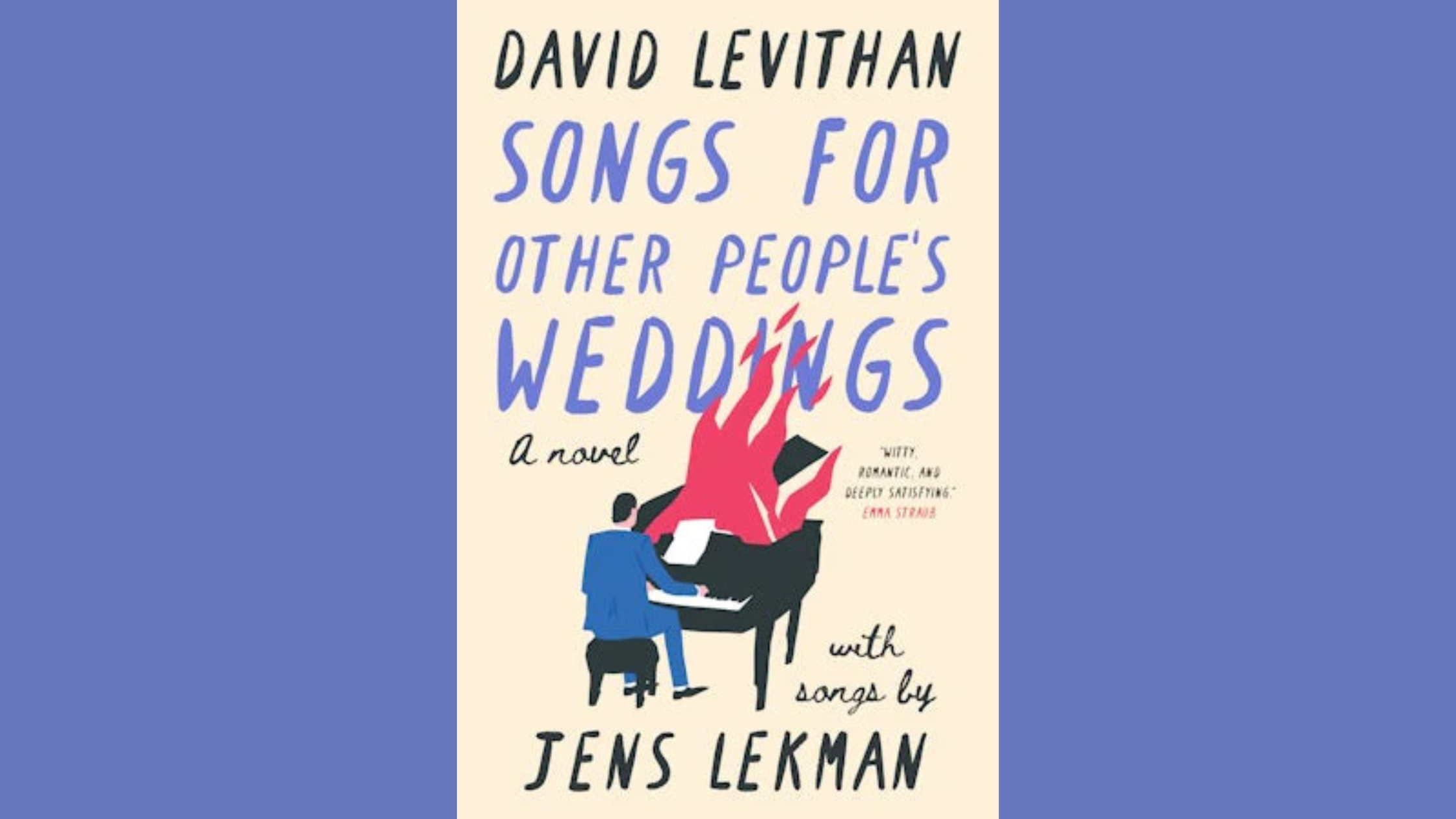
David Levithan and acclaimed singer-songwriter Jens Lekman have teamed up to write an intoxicating comedy about a lovelorn wedding singer, loosely based on Lekman’s own experiences as a part-time wedding singer. In Songs For Other People’s Weddings, readers meet J, a successful Swedish pop singer who supplements his income by writing customized songs for people’s weddings. His uncanny ability to crystallize a couple’s relationship into a song has made him a sought-after performer at weddings all over Sweden and the world. When his girlfriend, V, accepts a to-good-to-pass-up job offer in New York, both J and V find themselves struggling under the strain of a long-distance relationship. Over the course of ten memorable weddings, J must evaluate his feelings about love as his own relationship is put to the test. With Songs For Other People’s Weddings, Levithan and Lekman have crafted a deeply tender comedy about love, the many ways relationships evolve, and the intricacies of the creative process. The duo spoke to us about working together to create one of the summer’s most eagerly awaited books.
I wanted to start by asking a pretty basic question, but how did this book come to be? How did the two of you connect in terms of writing this book?
Jens Lekman: I contacted David in 2021, I think. I’d been working on the idea for a little bit, and I wanted to write it together with someone else. I thought, “Who would be the perfect person to write about this?” I thought of David, and then David came up with the way we were going to structure it.
David Levithan: We had met almost twenty years ago. I’d listened to a lot of his music while writing my books, and I reached out. Over the years, our orbits kept intersecting. I loved the idea. When I start a novel, it’s always about the premise and the way you can do it. This premise of this wedding singer who is basically grappling with his own questions about love while going to wedding after wedding after wedding, I thought, “My God, that is an amazing setup.” It was a fun balance because obviously I don’t have that experience myself. I’ve never been a Swedish wedding singer. (laughs) The fact that both of us were working on the book together took it into this interesting middle realm of it’s not autofiction, because only one of us has lived it or something like it, but it’s not completely out of my imagination, as my novels are. It was sort of a really amazing in-between.
I love how the songs weave in through the book and how they reflect the characters of the weddings we see. Which came first for you all, the songs or the characters?
JL: Initially, David came up with the idea that I was going to write the songs for fictional couples, send the songs to David, and he would write the chapters backwards from that. We did that for the first five chapters, right?
DL: The funny thing is, I can’t even remember which were which, because it was balanced out that some of them would be I would get a song and have to write the chapter that led to the song. But then other times I would write a chapter and then the song would have to come up. But it ended up being about half and half, where some of them I knew what it was leading to, and other times, I just wrote it and then said, “Here! Invent a thing!” (laughs) I think the most extreme case of that was probably the eighth chapter where there are these marriages at Borough Hall in Brooklyn, where it’s a number of short songs. That was purely me being like, “Here’s one. Here’s one.” Although even there, the whole time we were working on the book, Jens had said, “I would love to do one about the couple’s dog.” And then that was where that one came in.
JL: I think it was chapter five where you said, “I’ve already written the chapter and now you’ve got to write songs for these two people.” I was in a relationship that was falling apart. I looked at this chapter and I felt so badly for Sky, the character, and I think that changed something there. Up until that point, I just had to imagine a completely fictional couple. It was really hard to feel something for these couples that I had just invented in my mind. I was like, “I wonder who these couples are going to be, what they would have written for them or created for them.” Turning it around changed a lot, because then I could pour my own emotions into these characters.
J talks about how performing at a wedding is more vulnerable than performing at a concert, and how his wedding performances sometimes mean more. What did both of you want to capture about the experience of singing at someone’s wedding?
JL: For me—and I think this is bigger for me than maybe for David—but for me, the experience of singing at a wedding is an answer to what music is these days in the age of streaming. There’s something personal that has been lost, and there’s something about the purpose of music that has been lost. In weddings, that’s where I find that purpose again. It’s a very intimate moment. It feels like music is something very special there, rather than a playlist on Spotify called “Cappuccino Wednesday” played in the background of Starbucks.
DL: I think the dynamic was always fun in exploring this. Because again, I have never performed at a wedding, and if people are smart, they will never ask me to be a wedding singer. I approach music purely from the audience’s point of view. I’m somebody who finds so much meaning in listening to music and the community that music can bring. Half the time when I’m talking to my friends, we’re talking about music and about a song that just came out. “Have you heard this? What do you think of this? Who is the greatest pop singer right now?” It’s that notion of how music draws people together as a community. It was interesting to see it from both sides. At the wedding, the wedding singer is up on the stage and has this interesting participant/observer role. I could step back as an author and think purely as a participant as to what does it mean to them that they’re receiving these songs, and that these songs are part of what they wanted for their wedding. That was honestly very moving to me, thinking about what that means and how music draws everybody together. Even at the most fractious wedding ceremony where there are complex family tensions, the one place where everybody can get giddy and feel that love is on the dance floor.
The couples J meets in the book are all so compelling, and it’s a lot of fun to be briefly plunged into their lives. I’m curious about how you created the different couples, because they seem to reflect such a wide variety of thoughts on marriage and love.
DL: It was fun, because obviously, when you know they’re going to be ten different couples, you want them to be as different as possible and show a range. I’m sure if you picked ten random weddings there’d be more in common there than the couples we’ve chosen. But again, there were different dynamics at play. What was interesting to me is that for the most part all the couples are in love with each other. We did not play the card of having the couple that decides to break off the engagement at the altar, or something like that. In some ways, their reaction to the wedding songs very much is in correlation with their reactions to what music is within the wedding. The ones who view the wedding song as more of a commodity don’t actually get it as much. They’re more estranged from it. But the ones who are inviting it in as being part of their love for each other and wanting it to be emblematic of that—not for the novelty of having an original wedding song—they’re the ones who actually feel it much more. That was really interesting to play with, and to play with the different reactions. Some of the people in the Borough Hall chapter, they have a very short song, but it means a whole lot to them. It’s actually more meaningful to them than the very rich people who commission a song and then are just confused by it.
Jens, is that experience something that you’ve noticed singing at different people’s weddings?
JL: Absolutely. There are many different reasons why people book me for weddings, and sometimes I have felt like a commodity. I’ve played a handful of billionaire weddings, sort of like that wedding in chapter three. You do feel a little bit like you are a product there, like you’re part of this perfect image of their wedding or something. For me, I welcome those experiences as well. I like putting myself in strange and awkward situations. That’s one reason why I do these weddings. I think of myself as an observer, so those experiences are welcome too.
At one point, J describes being a wedding singer as a kind of midwife. I wanted to hear you both talk about how J views his role at these weddings.
JL: It’s hard for me to separate J and myself, but if I talk from my own perspective, which I think is what that moment is inspired by, I do feel like in one way I’m this very important person in the moment, like a midwife. I’m someone who delivers these people into the next phase of their lives, as I think J is saying there.
I have a role there. Sometimes that role is more or less defined. My role is to ease the anxiety that always occurs at weddings. Sometimes I’ll mess up a little bit. I’ll forget some lyrics in order to take a hit so that everyone else can relax. No one can really appreciate a wedding until someone has tripped or spilled cake all over themselves. I sometimes take that upon myself. But I also feel that singing these songs fills a purpose for these couples, and then I never see them again. Sometimes I do, but a lot of times it’s just this very short moment, and then they’re gone, and I’m at a bed and breakfast somewhere watching TV shows on my laptop. So it’s a strange feeling of being in this very important moment in these people’s lives, and then all of a sudden, it’s just gone.
DL: Talking about the experience with Jens was really fascinating. Just understanding that role and adding the element of bringing your own personal baggage of whatever is going on with you on that given day, and then amplifying that for the story. It’s as much about what’s going on with J and V as it is with whatever’s going on with the couple in front of J. Trying to navigate both things at once was really interesting to me. The notion that even when you are questioning, even when you are despairing, if you have a role to play, supporting other people, you put that aside and do the thing, but the cracks can still show through the work. Again, I think that is not uncommon for a novelist to have to do as well. But when you’re writing a story and you’re giving yourself to the characters, it’s absolutely informed by your own experience and whatever your emotions are that given day. But if your emotions don’t fit the chapter that you’re writing, you have to put that aside and do the thing. So I did relate to it in that way.
V is such an intriguing character and she and J are at a critical point in their relationship. Can you talk about V and why she was the perfect counterpoint to J as he is experiencing all this emotional tumult?
DL: What was interesting about the writing process is that V really came into her own and became more a part of the book the more we revised. We discovered her in terms of the story and in terms of getting her point of view to make it fully rounded. She’s somebody who has not ever been in the spotlight. She has not ever been the center of attention. She’s not a performer, but she has this opportunity arise that will cost her a lot. That’s always interesting to me as a novelist, of putting a character in a position where they can actually get something that they want and they’re right to want, but it will require some sacrifice or some changing of their lives. Again, not that they’re necessarily coming from a bad place and trying to get to a good place. It’s that weird situation of when you’re in a good place, but you actually could go to a better place and how do you navigate that? To me, that’s sort of the central question for her. What’s so hard on the relationship is that J is just a coefficient of that larger equation for her. That’s a horrible situation to be in in a relationship, when you want to plan around another person, but that other person isn’t actually going to plan around you. How do you navigate that? That’s really one of the central questions of the book, how they both navigate that and if it can lead to success. There’s a seesaw, because it’s very easy to write a book when there’s a clear right choice and a clear wrong choice. It’s much harder to write a book and to live a life when both choices have pros and cons and you still have to make a choice at the end.
While the book is mostly from J’s perspective, we also get scenes that are exclusively from V’s point of view where we gain a greater understanding of where she’s coming from. Is that something that came through revisions, or was that always there from the get-go?
DL: I think it was there, but only slightly in the first draft. And then it became more of a point. Because, again, the whole point of the book is that there are things that J doesn’t know. If J had access to them, then he would actually understand V much more than he does so. So shifting over into her point of view made it much easier for the reader to understand the situation which J, because of his lack of access to what V is thinking, can’t possibly know.
In the book, we get a peek behind the curtain in terms of what it takes to write a song. Can you talk about what you wanted to show in terms of how J finds creative inspiration to write all these different songs?
JL: What’s interesting was this was my favorite part of the of David’s writing. It’s funny because I didn’t think so much about what I was doing when I was writing wedding songs and I was playing at weddings up until we started working on this book. David actually kind of formulated to me through the writing how I felt. I don’t know how he understood that really, but he managed to formulate exactly the purpose of the writing, the motivation, and what it feels like to write the songs.
We also see V’s role in helping J craft the songs in terms of her being a sounding board or a first listener. I was curious to hear you all talk about the role that person can play in an artist’s life, whether it’s writing a song or writing a novel.
JL: Well, David has kind of been that person over the last few years of writing this. I would send these wedding songs to him, and he would say, “I like it, but maybe change this line,” or “to emphasize this, we need to change this chorus to this.” That’s been a new experience for me. My writing has mostly been solitary before. I’ve done a few collaborations, but not necessarily in the way where someone was involved in the writing of the songs. So that was very interesting.
DL: What I love—and again, I think this was very clear from the beginning—is that this is one of those collaborations where it’s a completely blurry line. This book, it’s ours. The story of J and V is ours. It was such a collaboration on all different levels that it’s very hard to isolate one thing from the other. It all just came together. I have done many collaborations, and that’s the ideal state. You never know going into it whether you’re going to get there, but it did work that way.
To your question, I loved that you used the phrase “sounding board,” because I do think that was the idea for V’s role in it. I feel “muse” has been so over-romanticized, and makes it sound like she’s the object and he’s just sitting there writing about her. The muse is rarely interactive. It’s usually from afar. With J and V, the whole point is that it’s interactive. If you have somebody who influences your work, it isn’t just by existing. It’s by actually giving you feedback, or you being able to internalize their sensibilities, so that it becomes one of the more positive—hopefully—voices in your head that makes you move things in one direction or the other.
So what does it take for the two of you in this collaborative process to get to that ideal state where it’s a blurry line in terms of who created what?
DL: We pretty much knew early on that we were on the same page. There didn’t have to be very much navigation, and the songs and the stories fit. Again, the premise was such a solid premise, I can’t emphasize that enough. But also, we approached it in that we knew I was not writing Jens’s autobiography. There was a lot of wide-open space to play, but if we wanted to zero in on a detail from his experience, we could. My favorite one to cite is when I wanted to find out what was it like to pass out inside a wedding cake, I could email Jens and ask, “What was it like to pass out inside a wedding cake?” Sadly the response was, “I was passed out.” (laughs)
The symbiosis was having that balance between fiction and reality, using the reality to make the details ring true, but for the overall story to be one that we were creating together. Ultimately, as with all my collaborations, it’s instinctual. Either it works or it doesn’t. Honestly, you know pretty early on whether it’s working or not. For us, it worked. There truly wasn’t any time that Jens sent me a song and I was like, “There’s no way we can use this. How would this go there?” And likewise, I believe there was no time I sent a chapter where Jens was like, “Why the hell did you write that chapter? Who is this couple? I can’t work this way.” (laughs) We knew. And again, it wasn’t a shot in the dark. I’ve been listening to his music for twenty years. Jens knows what kind of writer I am. It’s not like we went into this blindly. I think there already was an assumption that these two styles and the way that we look at the world, even though we chose different forms of art to express it, there’s actually a huge commonality there. I think that commonality led to us being on the same page for this book.
JL: Another thing that was interesting about writing this was that it led us to conversations about love and relationships, as well. There were moments when I would read a chapter and I would go, “Would someone actually be like that in a relationship? Would someone act like that?” Then we would talk about it for a long time, “Oh, yeah, I’ve been through this experience.” That was what was interesting to me, that it felt like a dialogue about love.
And finally, what role has the library has played in your life?
JL: It was very important for me, because I grew up in a place that was troubled by socio-economic problems. A lot of people were living under quite cramped conditions, with a lot of people and big families in tiny concrete apartments. The library was the place where you could escape and just have some peace and quiet and do your homework or just find a book or, in my case, mostly music, to be honest. The local library had a great selection of music. I keep being asked, and I almost always say yes, to doing library benefit shows. I can’t even remember how many of those I’ve done over the years. Every time they try to close down a library—and they always want to close down libraries here, for some reason—I go out like some sort of Batman of the libraries to save them.
DL: It could take another half hour for me to answer this question. My first job was at the school library. I started off in the back of the library, stripping books and hanging out with the librarians and just seeing the way that they saw the world. Calling back to what we were talking about earlier, about community, the library community has been one of the great communities of my life, both as a kid and as somebody who worked in the library, but then also both as a writer and as an editor. I have so many friends who are librarians and we’ve supported each other over the past twenty-five, thirty years. I’m working right now with authors against book bans and all of the challenges that they’re facing. That’s been this past year. As much as I’m an author and a publisher and an editor, my biggest job has been fighting book bans. I’ve been working with all of the people who are on the ground doing the grassroots work to make sure that librarians are respected, their expertise is respected, and that they can put all of the voices onto their shelves that they should put onto their shelves. Again, it’s a very long relationship, but it is a very, very valuable one to me, and is sort of in the DNA of who I am.
Tags: David Levithan, Jens Lekman