The Librarian’s New Role: Knowledge Discovery

For more than thirty years I have been interested in one deceptively simple question:
How do we find things?
At first glance, the answer appears obvious. We search. But anyone who has spent a lifetime in libraries knows that searching and finding are not the same thing.
Throughout my earlier articles in Public Libraries Online, I explored several aspects of this process. In Finding Answers, I argued that patrons rarely come looking for information; they come looking for answers. In Search vs. Research, I suggested that locating information is only the beginning of inquiry. In Keeping Things Found, I examined what happens after discovery, how knowledge is preserved, organized, and made retrievable for future use.
Artificial intelligence is now transforming how people search and, perhaps more importantly, how they find. For the first time in history, millions of people no longer begin by opening a directory, consulting an index, or scanning pages of search results. Instead, they ask a question in ordinary language and receive what appears to be a finished answer.
This is more than another improvement in search technology. It represents a fundamental change in the relationship between people and information.
The question librarians should be asking is not whether artificial intelligence can answer questions. It clearly can.
The more important question is this:
What happens to the process of finding?
Some have suggested that artificial intelligence will replace librarians. History suggests the opposite. Every time information becomes easier to access, the ability to evaluate it becomes more valuable. When everyone can obtain an answer instantly, expertise shifts toward determining which answers deserve trust.
Reference librarians have always taught people how to ask better questions. Increasingly, they must also teach people how to evaluate better answers. That may become one of the profession’s most valuable contributions.
In many ways, AI also returns us to one of humanity’s oldest methods of seeking knowledge. Long before books, catalogs, and search engines, people learned by asking knowledgeable individuals questions. Printed indexes and digital search engines inserted layers between the question and the answer. AI is restoring something closer to a conversation.
The tools have changed, but the essentials of good research have not. Curiosity, skepticism, evidence, and sound judgment remain indispensable.
To understand what semantic discovery might look like in practice, I recently experimented with applying artificial intelligence to a large archival email discussion list. The list contains years of conversations among experts in recorded sound preservation, an extraordinary body of practical knowledge that has always been difficult to search efficiently.
Traditional searching asks, *What words appear in this message?* Instead, I asked a different question:
What is this discussion really about?
Using AI, we developed a semantic index rather than a traditional keyword index. Discussions were organized around concepts such as copyright, digitization, metadata, collection management, preservation, and equipment. Individual messages could belong to multiple concepts simultaneously because real-world discussions rarely fit neatly into a single category.
A conversation about preserving shellac recordings, for example, might also relate to audio restoration, digitization, copyright, metadata, playback equipment, and collection management. Another message written years earlier might surface because it explored the same underlying problem, even though it used entirely different terminology.
The result was not simply a better search index. It was a different way of discovering knowledge.
Traditional indexes answer the question: 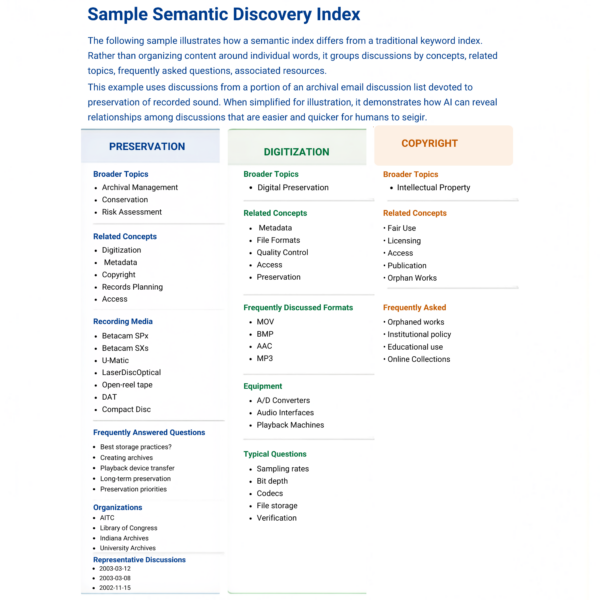
- Where does this word appear?
- Semantic indexes answer a more meaningful question:
- Where has this idea been discussed?
This distinction has occupied information scientists for decades. Librarians have long pursued semantic discovery through subject headings, thesauri, citation indexing, ontologies, concept maps, and other systems designed to organize ideas rather than words.
What artificial intelligence changes is not the goal. It changes the scale. Tasks that once required months of manual analysis can now be completed in minutes, making semantic indexing practical for collections that previously would have been impossible to organize this way.
Looking back, the history of libraries can almost be viewed as a progression in how knowledge is organized:
- In the nineteenth century, we organized books.
- In the twentieth century, we organized subjects.
- Later, we organized records and databases.
- Then we organized digital documents.
- Today, with AI, we are beginning to organize ideas.
Libraries have been preparing for this transition for more than a century.
Although the title of this article refers to a “new” role for librarians, the concept itself is not entirely new. Special librarians have long served as knowledge managers within corporations and research organizations. What has changed is not the mission but the tools available to accomplish it.
Artificial intelligence will undoubtedly continue to reshape how people retrieve information. Yet the librarian’s enduring role remains remarkably consistent: helping people discover, evaluate, and understand knowledge.
The question has never really been how people search. It has always been how people find.
AI may provide answers, but librarians provide context, judgment, and trust. Those qualities have always defined the profession, and they may become even more valuable as information becomes easier to generate but harder to evaluate.